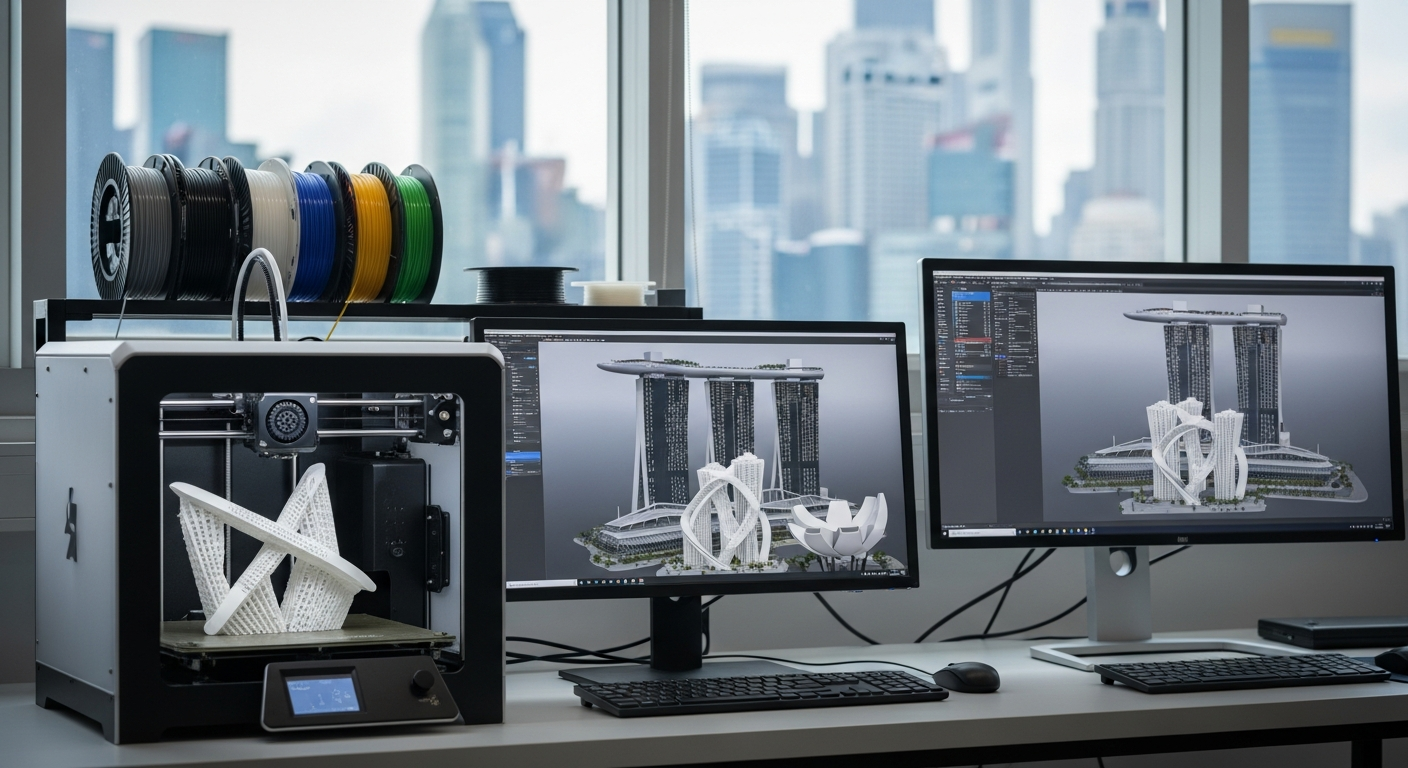
The 2025 landscape for CAD modeling Singapore and FDM 3D printing
By 2025, Singapore’s maker and manufacturing scene has continued to evolve into a hybrid of creative studios, rapid-prototyping hubs and boutique production houses. Demand for fast, accurate product-development cycles — from collectible art toys to functional engineering parts — means CAD modeling Singapore and FDM 3D printing Singapore services are increasingly integrated into both creative and industrial workflows.
This article breaks down practical workflows, CAD best practices, FDM settings and business considerations so you can reduce iteration time, control costs and get repeatable results whether you’re a designer, small studio or product developer.
Why precise CAD modeling is the foundation
CAD is more than geometry — it’s a communication tool between designer, engineer and manufacturer. Good CAD modeling Singapore workflows in 2025 emphasize:
- Intent-driven design: models that encode function (assembly fits, snap features, screw bosses) rather than just visual surfaces.
- Tolerance-aware parts: FDM printers have variability; designing with realistic clearances reduces trial-and-error.
- Modular files: keeping separate components as assemblies makes revisions and slicing more efficient.
Top tips:
– Model assembly constraints and mating faces; don’t rely on manual adjustments after printing.
– Use simple parametric features where possible so you can quickly tweak wall thickness, fillets and snap fits.
– Export both STL for printing and native CAD files for later edits.
Key CAD modeling best practices for FDM parts
Design choices in CAD dictate how an FDM print will perform and finish.
- Wall thickness and shell strategy: aim for feature thicknesses that are integer multiples of nozzle width. A 0.4 mm nozzle often means 0.8–1.2 mm thin walls for reliable prints.
- Fillets and chamfers: add small fillets (0.5–1.5 mm) on load-bearing corners to reduce stress concentration.
- Clearance and tolerances: for press fits expect 0.2–0.5 mm clearance depending on printer and material; for sliding fits, increase slightly.
- Split complex models: design printable sub-parts with registration features to avoid excessive supports and to enable controlled surface finish.
CAD tools with cloud collaboration and AI-assisted surfacing are now mainstream in Singapore, speeding concept-to-file time for both product and art projects.
FDM 3D printing Singapore: materials and when to use them
FDM is versatile but material choice shapes cost, strength and post-processing.
- PLA: easy, low-warp, good for prototypes and display models. Ideal for figurines and decorative pieces.
- PETG: tougher than PLA, good chemical resistance. A go-to for functional prototypes needing some flexibility.
- ABS / ASA: heat-resistant and durable; ASA is preferred outdoors (UV resistant) in humid climates like Singapore.
- TPU and flexible filaments: great for grips, seals and soft-touch parts but require tuned extrusion parameters.
For collectible art toys and limited editions, combining rigid cores with flexible overmolds can deliver both durability and tactile appeal. For more on art toys and custom figurine design, see this resource on limited edition art toys in Singapore: limited edition art toys Singapore.
Optimizing print settings for quality and speed
Balancing speed and surface quality is the most common trade-off.
- Layer height: 0.1–0.2 mm for high-detail figurines; 0.2–0.3 mm for faster prototypes.
- Nozzle size: 0.4 mm is versatile; 0.25 mm for fine details; 0.6–0.8 mm for strong structural parts.
- Infill patterns: gyroid or cubic for isotropic strength; line or grid for speed and low material use.
- Support strategy: orient parts to minimize supports; use tree supports where available to reduce touch points.
- Cooling and temperatures: tune part cooling for PLA high-detail work; reduce fan for ABS/ASA to avoid delamination.
If you’re beginning FDM for collectible toys, consult a specialist guide like the 2025 guide to FDM 3D printing Singapore for figurines for specific material and finishing recipes.
From concept to finished part: a reproducible workflow
A repeatable pipeline reduces surprises.
- Brief & constraints: Define function, final use environment, required tolerances and finish.
- CAD modeling: Build intent-based geometry and test assemblies virtually.
- File preparation: Export high-quality STL; check normals, manifoldness and scale.
- Slicing: Choose layer height, infill, supports and shells. Run simulation if available.
- Print & monitor: Use time-lapse or remote monitoring for long jobs; log failed prints for iteration.
- Post-processing: Support removal, sanding, priming and painting. For smooth finishes use primer-sanding cycles or chemical smoothing for ABS.
- QA & fit testing: Verify critical dimensions and assembly behavior. Adjust CAD if needed.
For fast turnarounds and production runs, consider hybrid services that combine CAD, in-house AI simulation and finishing. An example of an integrated option is AI-ready rapid prototyping Singapore.
Cost, lead time and sustainability considerations
Singapore’s compact supply chain makes short runs inexpensive relative to long international shipping times, but costs still depend on complexity and finish.
- Cost drivers: material volume, print time, amount of post-processing, surface finishing and color matching.
- Lead time: single-part prototyping can be hours to a day; batch runs and finishing add days.
- Sustainability: optimize infill, use recycled or biodegradable filaments where appropriate, and design for minimal supports to cut waste.
Budget-conscious projects (common in the collectibles space) can use specialized services for economies of scale — see tips for budget FDM approaches here: budget FDM 3D printing for collectible art toys Singapore.
Choosing between in-house printing and external services
Deciding whether to print in-house or outsource depends on volume, expertise and capital.
- In-house: best for continuous iteration, fast test cycles and hands-on finishing. Requires investment in machines, maintenance and operator training.
- Outsource: ideal for one-off runs, high-quality finishing or when you need a partner for mold making and painting. Good partners often provide integrated CAD refinement and finishing.
If commissioning finished collectibles or limited runs, a single-provider service can reduce coordination time — for example, ordering end-to-end custom figurines: order custom figurines with 3D printing Singapore.
Quick troubleshooting & common failure modes
- Warping and edge lift: increase bed adhesion, add brim, use enclosure and choose low-warp materials.
- Layer delamination: raise extrusion temperature, improve interlayer time or switch to a higher-temperature filament.
- Stringing on detailed parts: tune retraction distance and speed; lower print temperature slightly.
- Missing fine detail: use smaller nozzle or reduce layer height; ensure slicer settings capture small features.
A pre-flight checklist before sending files can catch many issues: manifold check, minimum wall thickness, support touchpoints, part orientation and intended final material.
Use cases in Singapore’s creative and industrial sectors
- Collectible art toys and limited editions: designers leverage CAD modeling Singapore workflows to iterate sculpts quickly and produce small batches using FDM and post-processed surfaces.
- Rapid product validation: startups use FDM prototypes to validate ergonomics and assembly before injection-mold tooling.
- Educational and research: universities and labs use accessible FDM setups for proof-of-concept studies and custom test rigs.
For practitioners focused on collectible art and limited runs, look at real examples of limited edition workflows and how studios handle finishes: limited edition art toys Singapore.
Final checklist before print submission
- Exported files: STL and original CAD saved, versioned and labeled.
- Material & finish specified: color codes, surface roughness and painting instructions.
- Assembly & tolerances documented: mating parts and fit expectations.
- Post-processing notes: priming, sanding, staining or chemical smoothing.
- Delivery & quantities: expected lead time and batch sizes.
For teams that want practical, production-aware guidance on tooling and costing, the local ecosystem offers tutorials and partner studios focused on both quality and budget performance — see more on ordering and partner services here: AI-ready rapid prototyping Singapore, and a focused ordering option at order custom figurines with 3D printing Singapore.
Closing perspective
CAD modeling Singapore teams and FDM 3D printing Singapore services are converging into integrated, faster cycles in 2025. By designing with manufacturing in mind, selecting the right materials and partnering with experienced finishing shops, you can cut iterations and deliver pieces that meet both functional and aesthetic goals. Whether you’re producing collectible art toys or functional prototypes, clarity in CAD intent and disciplined FDM workflows are the two levers that deliver predictable, high-quality results.